

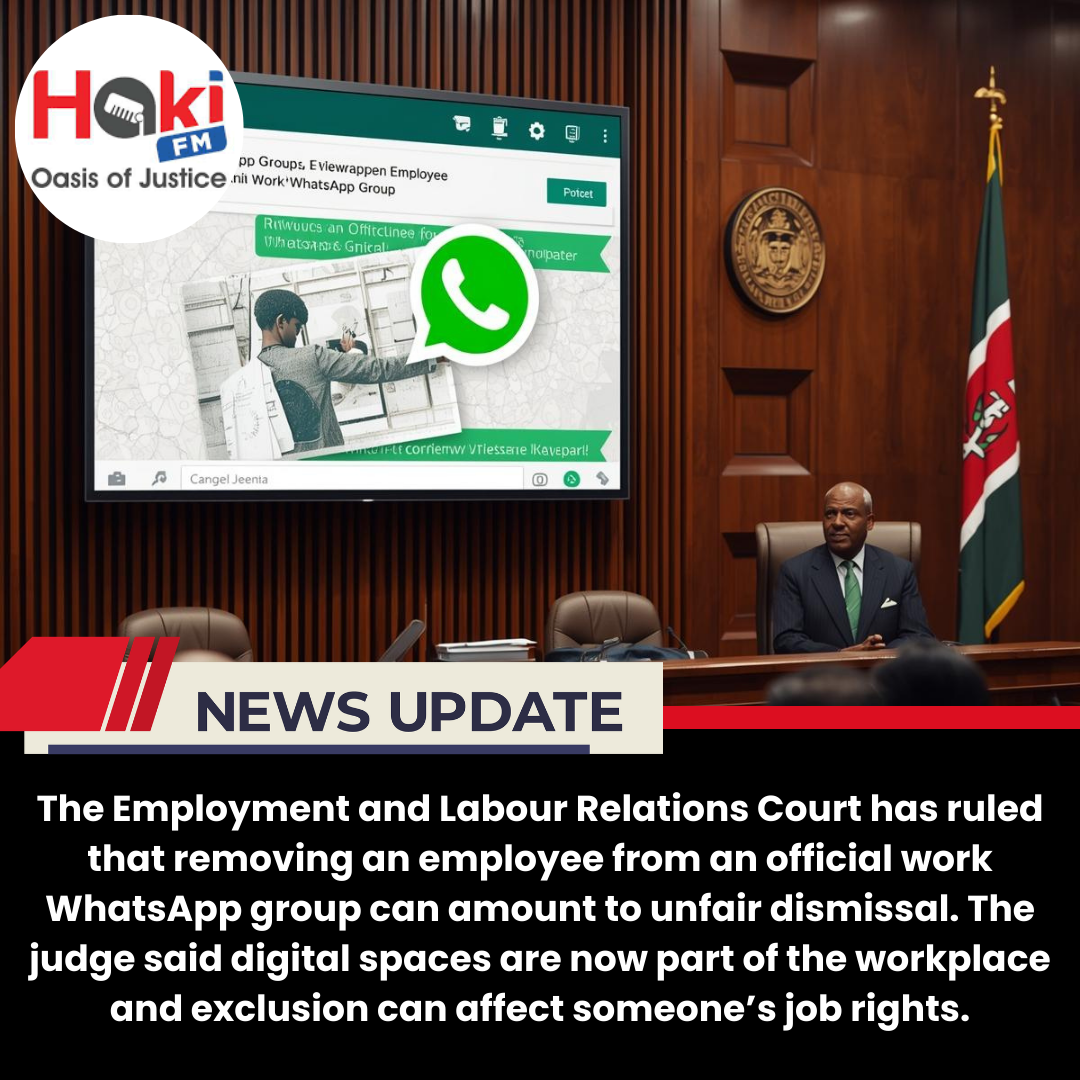
A Kenyan court has ruled that removing an employee from official workplace WhatsApp groups can, in certain circumstances, amount to unlawful termination, marking a significant step in how digital communication platforms are treated under employment law.
In a landmark judgment delivered by the Employment and Labour Relations Court, the judge found that excluding an employee from workplace communication channels while she was on medically authorized leave effectively severed her from her role and signaled termination of employment. The employee was awarded approximately KSh 4.4 million in damages.
The case involved a worker who was removed from multiple work-related WhatsApp groups and blocked from official communication platforms during pregnancy-related sick leave. The court held that such actions were not minor administrative decisions but had real professional and legal consequences, amounting to constructive dismissal and discrimination.
In its ruling, the court emphasized that digital platforms like WhatsApp have become central to modern workplace operations. Being excluded from these spaces can isolate an employee from daily responsibilities, workplace decisions, and professional engagement, effectively ending their ability to perform their duties.
The judgment highlighted constitutional protections including equality, dignity, and fair labor practices, stating that employers must consider the legal implications of digital exclusion just as seriously as traditional dismissal procedures.
Legal experts say the ruling reflects a broader shift in labor law as courts begin to recognize that workplace communication has moved online. “A WhatsApp group today can function like an office notice board or staff meeting,” one analyst noted, adding that exclusion can carry tangible employment consequences.
The ruling adds to a growing body of global case law related to WhatsApp group management. In a separate precedent from India, a High Court ruled that WhatsApp group administrators cannot automatically be held criminally liable for posts made by other members, since admins mainly control membership rather than content moderation.
Together, these decisions highlight how courts are balancing personal digital rights with the evolving responsibilities tied to online communication spaces.
Labour specialists warn that companies relying on messaging apps for official communication may need clearer policies on digital inclusion and employee rights. Employers could face legal consequences if workers are removed from official channels without proper process or justification.
For employees, the decision signals judicial recognition that exclusion from digital workspaces may be interpreted as a serious employment action rather than a casual managerial move.
As workplaces increasingly operate through virtual platforms, the ruling is likely to influence how organizations across Kenya and potentially beyond manage communication in the digital age.